
Impartiality is a common theme amongst conformity assessment schemes. By definition, impartiality is the absence of bias. The International Standards Organization (ISO) establishes the significance of this concept in every conformity assessment scheme (CAS). Specifically within ISO/IEC 17065, the importance of impartiality is further solidified through the requirement of a mechanism for safeguarding impartiality. The intent of this mechanism is to ensure that actions related to the certification activities are conducted impartially by the certification body (CB).
Responsibility of the Mechanism
Per clause 5.2.1, the responsibility of the mechanism is to provide input on:
- the policies and principles for the impartiality of the certification activities
- For example, the mechanism may suggest changes to the CB’s policy on impartiality.
- any inclination by a certification body to allow influences to affect the impartial execution of certification activities
- For example, the CB offers an “expedite fee” for clients that want faster turnarounds on their certification decisions. The mechanism can review this process and determine that it is not structured in a way to safeguard impartiality.
- matters that can affect trust in the certification body’s certification activities
- For example, one of the test labs utilized for the evaluation activities was found to be issuing fraudulent test reports. The mechanism may determine that this could impact trust in the certification activities.
Balanced Representation
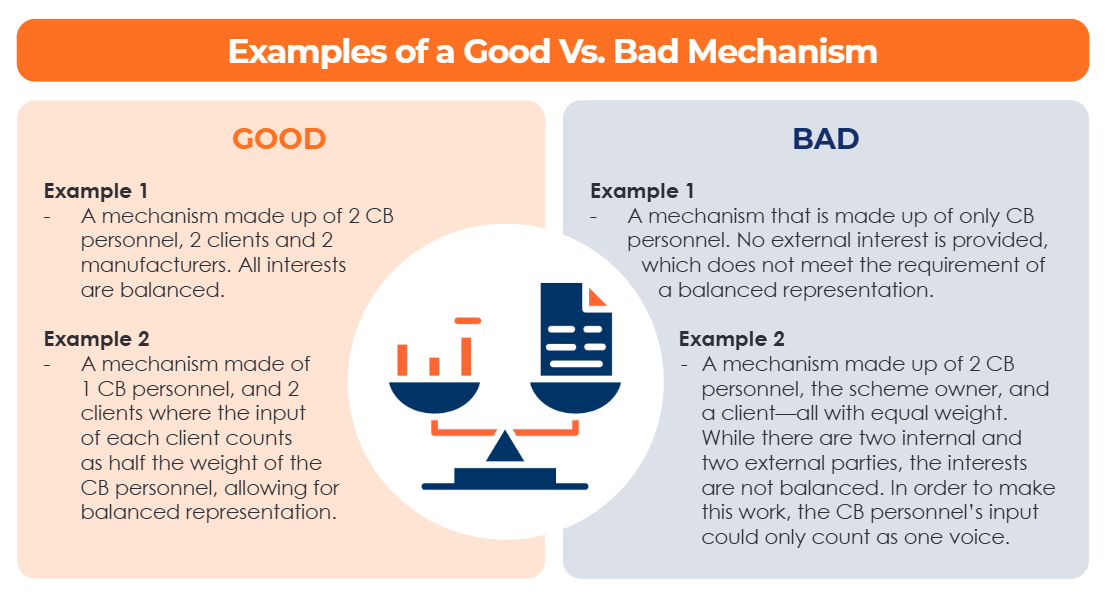
Per clause 5.2.2, the mechanism shall have balanced representation. In other words, all participants of the mechanism shall have equal input. Representation can come from interested parties such as personnel, clients, the scheme owner, regulators, or other certification bodies. The expectation of the CB is to ensure that every effort is made to achieve a balanced representation. Once the mechanism is determined, the representatives shall be documented.
Clause 5.2.4 acknowledges that balanced representation may not be possible in some instances; however, the CB is expected to continue to seek participation from interested parties. Failure to do so could result in a nonconformance against 5.2.2 during an assessment.
Participation can be weighted in order to ensure the mechanism is balanced. For example, if the mechanism was made up of two personnel and the scheme owner, the input of the personnel could be half the weight of the scheme owner. By doing so, the overall input of the CB would be equivalent to the input of the scheme owner.
Mechanism Input
Clause 5.2.3 is made up of two parts. The first part allows for appropriate action to be taken in the instance that top management does not follow the input of the mechanism. This may include alerting authorities, the CB’s accreditation body, or any other relevant stakeholders (such as the scheme owner). In this instance, the requirements for confidentiality (section 4.5) shall be taken into account.
The second part of 5.2.3 notes that input that goes against the CB’s requirements should not be followed, with the expectation that the justification for not following the input should be documented and reviewed by appropriate personnel. Note the use of the word “should” in this portion of the clause. By definition within the standard, the word “should” means “recommendation.” As such, if a CB chooses not to follow this portion of the clause, it is valid since the language indicates it is a recommendation over a requirement.
Ready to start your accreditation journey with A2LA? Request a quote today!