
What laboratories should know, with the Artel MVS used as one practical example of an ISO 23783-aligned measurement approach
About this blog
 This article was created by Nicholas Enea, Artel Biopharma Product Manager at Nova Biomedical, in conjunction with A2LA. Nicholas leads product strategy for the company’s liquid handling verification portfolio, including the MVS platform. His work centers on helping pharma, biotech, and clinical laboratories bring accuracy, traceability, and confidence to automated and manual liquid handling. He is particularly focused on the growing role of ISO 23783 and accredited verification as automation continues to scale across the industry.
Why this topic is coming up more often
Automated liquid handlers are no longer limited to a few specialized, high-throughput laboratories. They are used across drug discovery, assay development, genomics, cell and gene therapy, clinical workflows, and bioprocessing. In many of those settings, a single method can depend on hundreds or thousands of liquid transfers. If the transfer step is not performing as expected, the effect can carry through the rest of the workflow.
That does not mean every automated transfer requires a formal calibration. It does mean laboratories need a sensible way to decide what should be tested, how the test should be run, and what the result actually demonstrates. Until recently, organizations often adapted internal procedures, vendor recommendations, or methods developed for manual pipettes. Those approaches can be useful, but they do not always account for the way automated systems are configured and used.
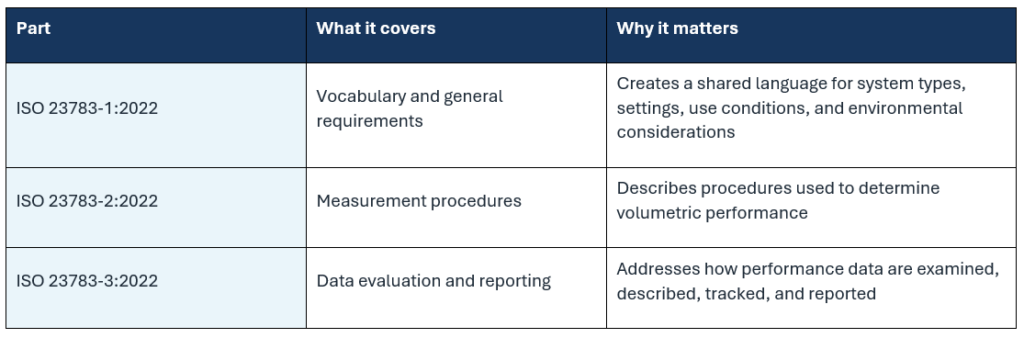
ISO 23783 was developed to provide a dedicated framework for automated liquid handling systems. The series was published in 2022 and replaced IWA 15:2015. It separates the topic into three parts, which makes the overall structure easier to follow.
A standard can define what good measurement practice looks like without prescribing a single instrument. Laboratories may use gravimetric, photometric, or other suitable procedures when the selected approach is appropriate for the system, volume range, liquid, environment, and required uncertainty.
The three parts of ISO 23783
Why an automated system is not just a larger pipette
The underlying question is familiar: did the device deliver the intended volume with acceptable accuracy and precision? The challenge is that an automated platform introduces more variables than the handheld device itself. Performance may depend on the liquid-handling head, tips, liquid class, aspiration and dispense settings, deck position, labware geometry, mixing, timing, software configuration, and properties of the liquid being transferred.
For that reason, a result has limited value unless the tested configuration is clear. A laboratory should be able to explain what was tested, which settings were used, what liquid and labware were involved, and how the measurement relates to the actual application. The same automated platform can perform differently when any of those factors change.

How ISO 23783 relates to ISO 8655
ISO 8655 is the established series for piston-operated volumetric apparatus, including pipettes, burettes, dilutors, dispensers, and manually operated precision laboratory syringes. ISO 23783 addresses automated liquid handling systems that carry out liquid handling tasks without human intervention into the labware.
The two series share core metrological principles. Both require attention to the item being tested, the measurement procedure, relevant environmental conditions, error and variability, measurement uncertainty, traceability where required, and clear reporting. The difference is the equipment and the way it is used. ISO 23783 accounts for system-level factors that are specific to automated platforms.
It is therefore reasonable to think of the standards as related, but not interchangeable. The applicable method should follow the equipment, the requested activity, and the intended use of the result.
Where ISO/IEC 17025 fits
ISO/IEC 17025 is broader than any one measurement method. It is the international standard used by testing and calibration laboratories to demonstrate competence, impartiality, and consistent operation. It addresses personnel, facilities, equipment, metrological traceability, method selection and validation, measurement uncertainty, data control, assurance of result validity, reporting, and management-system requirements.
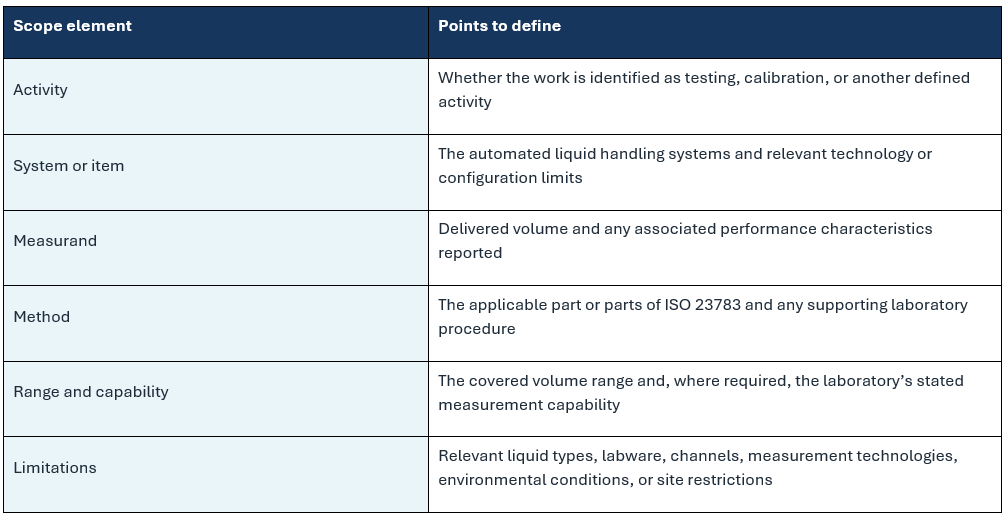
ISO 23783 can provide the technical method basis for defined automated liquid handling activities. ISO/IEC 17025 provides the framework for demonstrating that the laboratory is competent to perform those activities. A laboratory seeking accreditation would still need to work with its accreditation body to define the requested scope and demonstrate competence for the specific methods, measurands, ranges, and limitations involved.

What an accreditation scope may need to make clear
A practical example: applying ISO 23783 with the Artel MVS
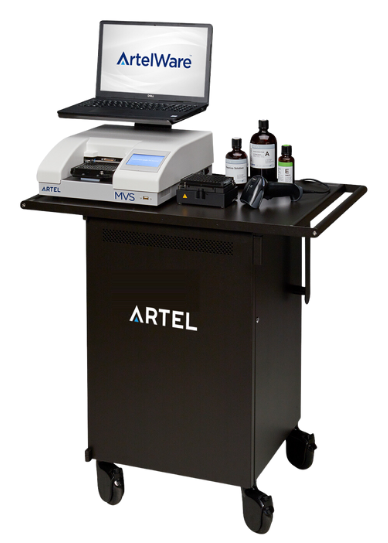 The Artel MVS is one way a laboratory can put the volumetric-performance concepts in ISO 23783 into practice. The system uses dual-dye ratiometric photometry to determine the volume delivered into individual wells of a microplate. Nova Biomedical states that the method is traceable to SI units and that the MVS conforms to the dual-dye ratiometric photometric and ratiometric photometric methods described in ISO 23783-2:2022.
In a typical automated liquid-handler evaluation, the liquid handler dispenses MVS Sample Solution into a Verification Plate. The plate is read using an Artel-certified plate reader, and the software calculates well-level volume results and summary statistics. This makes the approach useful when a laboratory wants to look across multiple channels or positions rather than infer performance from a small number of isolated measurements.
Where the MVS approach can be useful
- Testing many wells and channels in a plate-based format, including 96- and 384-well workflows
- Comparing performance across channels, deck positions, liquid classes, methods, operators, instruments, or sites using a consistent measurement system
- Supporting installation work, routine verification, troubleshooting, method transfer, or liquid-class optimization
- Reducing sensitivity to some environmental influences that can complicate low-volume gravimetric measurements
- Producing results that can be reviewed at the well, channel, plate, and run level
What the MVS does not decide for the laboratory
The measurement system does not determine whether a study is fit for purpose. The laboratory must still define the tested configuration, select volumes and liquids that represent the application, establish replicates and acceptance criteria, evaluate measurement uncertainty, control data and records, and decide how the result will be used. A successful MVS run demonstrates performance under the conditions tested; it should not automatically be treated as proof of every method, liquid, labware type, or operating condition used on the platform.
The MVS also may not be the best choice for every situation. The plate-based photometric workflow uses specified reagents, compatible labware, and a qualified reader. A laboratory may prefer gravimetry or another method when testing non-plate formats, unusual liquids, volumes outside the supported range, or applications where the measurement principle does not match the intended use. Method selection should be driven by technical suitability and uncertainty requirements, not brand preference.

Planning an evaluation that will hold up later
Most problems with performance studies are not caused by the final calculation. They begin earlier, when the purpose, configuration, or decision criteria have not been defined clearly enough. A practical planning discussion should cover the following points before testing starts:
- The workflow or risk the result is intended to address
- The exact system configuration, including channels, tips, liquid class, labware, software version, and relevant method settings
- The measurement procedure and why it is suitable for the volume range, liquid, and required uncertainty
- The number and location of measurements, sequence of testing, acceptance criteria, and treatment of invalid observations
- Environmental or procedural influences such as evaporation, timing, mixing, contamination, and carryover
- The specification and decision rule that will be used if a conformity statement is reported
The goal is not to make every study unnecessarily complex. The goal is to record enough information that a technically informed person can understand what the result represents and compare it meaningfully with later work.
What a useful report should tell the reader
A pass/fail statement is rarely enough on its own. The report should identify the system and configuration, the method used, the relevant conditions, the data treatment, and the results. Where applicable, it should also address measurement uncertainty, metrological traceability, deviations, and the decision rule used for any conformity statement.
The level of detail should be appropriate to the purpose of the work. A routine internal check may not require the same report as an accredited calibration, but both should be clear about what was measured and what conclusion can reasonably be drawn from the result.
Questions worth asking before accepting a result
These questions apply regardless of measurement platform. For an MVS study, they also help distinguish a well-designed evaluation from a plate read that lacks application context.
- Which automated liquid handling configuration was actually tested?
- Which part or parts of ISO 23783 were applied, and were there any deviations?
- Is the work covered by the laboratory’s current ISO/IEC 17025 scope?
- Why was the selected measurement procedure appropriate for this application?
- How were measurement uncertainty and metrological traceability addressed?
- Which variables were controlled, fixed, or recorded?
- How were failed controls, reruns, and invalid observations handled?
- What specification and decision rule were used?
- Does the report contain enough detail to support a future comparison or investigation?
Closing perspective
Automated liquid handling has become part of routine laboratory operations, but the quality infrastructure around it is still maturing. ISO 23783 gives laboratories, customers, calibration providers, and accreditation stakeholders a common technical reference. That common reference can reduce ambiguity and make conversations about performance more productive.
The standard does not remove the need for technical judgment. The Artel MVS can provide a fast, plate-based, SI-traceable way to generate volume data using a method described in ISO 23783-2, but the strength of the conclusion still depends on the study design and the laboratory’s quality controls. Used appropriately, the MVS is not the standard itself. It is a practical tool for applying part of the standard to real automated liquid handling work.

References and further reading
- International Organization for Standardization. ISO 23783-1:2022, Automated liquid handling systems, Part 1: Vocabulary and general requirements. https://www.iso.org/standard/76952.html
- International Organization for Standardization. ISO 23783-2:2022, Automated liquid handling systems, Part 2: Measurement procedures for the determination of volumetric performance.
- International Organization for Standardization. ISO 23783-3:2022, Automated liquid handling systems, Part 3: Determination, specification and reporting of volumetric performance. https://www.iso.org/standard/76959.html
- International Organization for Standardization. ISO 8655-1:2022, Piston-operated volumetric apparatus, Part 1: Terminology, general requirements and user recommendations. https://www.iso.org/standard/68796.html
- International Organization for Standardization. ISO/IEC 17025:2017, General requirements for the competence of testing and calibration laboratories. https://www.iso.org/ISO-IEC-17025-testing-and-calibration-laboratories.html
- Nova Biomedical. Artel MVS Multichannel Verification System product information, including method, traceability, and ISO 23783-2 conformity statements. https://www.novabiomedical.com/liquid-handling-verification/mvs-multichannel-verification-system/
- Nova Biomedical. Publications and references citing Artel MVS technologies and dual-dye ratiometric photometry. https://www.novabiomedical.com/resources/knowledge-center/publications-and-references-citing-artel-mvs-technologies-solutions/