
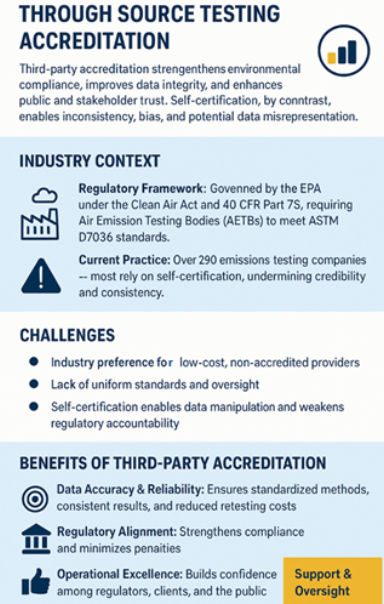
 When organizations comply effectively with EPA regulations, it enhances transparency and accountability. It also improves data accuracy, something that is vital when emissions data influence policy decisions, enforcement, and public trust. So, understanding and aligning with these frameworks isn’t optional; it’s critical to maintain environmental integrity and operational credibility.
The future of emissions testing hinges on two things: data integrity and compliance reliability. Without those, it’s impossible to make informed environmental decisions or enforce regulations effectively. Transitioning to third-party accreditation is one of the most impactful ways we can strengthen those foundations. It provides independent oversight, builds trust in the data, and ultimately leads to stronger environmental protections.
Working with a Third-Party Accreditation is Easy!
Step 1: Determine the option that would best apply to your organization.
Option A: Falls under the A2LA ILAC MRA and offers global recognition to the AETB. Labs are assessed to the ISO/IEC 17025 requirements, FSMO Volume 1 Standard Requirements, and ASTM D7036.
Option B: Covered under the A2LA ILAC MRA Scope of Recognition. Labs are assessed to the ISO/IEC 17025 requirements and the FSMO Volume 1 standard requirements.
Option C: Not covered under the ILAC MRA but is accepted by the Source Evaluation Society. Labs are assessed to the ASTM D7036 requirements.
Step 2: Request a Quote/Submit your Application.
Step 3: Assessment is opened, application reviewed, and assessor is assigned.
Step 4: Assessor schedules the assessment and assessment occurs.
Step 5: Assessor will submit their report.
Step 6: Corrective Actions are to be submitted.
Step 7: The Accreditation Council will review the assessment package.
Step 8: Accreditation will be granted/renewed upon closure of nonconformances.
The EPA Office of Inspector General (2024) reported nationwide inconsistencies in emissions testing and urged the creation of national accreditation standards to ensure reliability and integrity in data reporting. When every region and testing body follows the same criteria, it ensures reliable and comparable emissions data nationwide, and strengthens the integrity of our environmental oversight systems. The report didn’t just flag inconsistencies. It also highlighted gaps in compliance protocols. This points to the need for unified, enforceable standards to close those gaps and ensure that all testing bodies operate on a level playing field. Accreditation provides structure and confidence while improving data integrity, ensuring regulatory compliance, enhancing industry competence, and ultimately resulting in cost savings by reducing the need for retesting and minimizing risk exposure. Overall, the findings reinforce accreditation is not just helpful—it’s necessary!
For more information about A2LA’s Air Emissions Testing Body Accreditation Program, visit A2LA.org/accreditation/aetbs. Ready to request a quote? Visit A2LA.org/estimate-request.