
 The National Animal Health Laboratory Network (NAHLN) is a nationwide network of veterinary diagnostic laboratories that protects animal health, agriculture, and public health. NAHLN was launched in 2002 with the goal of creating a connected network of veterinary diagnostic laboratories that could detect disease early, respond quickly, and provide results that stakeholders could trust. As the network grew, so did the need for a consistent approach to laboratory quality and competency. By 2008, NAHLN was formalizing accreditation expectations around American Association of Veterinary Laboratory Diagnostics (AAVLD) and ISO/IEC 17025. The message was simple; if laboratories are going to be relied upon during major animal health events, their results need to be accurate, reliable, and defensible. Today, accreditation remains a key part of maintaining confidence in NAHLN and ensuring laboratories are ready when it matters most.
NAHLN have two primary accreditation pathways; AAVLD accreditation or ISO/IEC 17025 accreditation through an independent third-party accreditation body, such as American Association of Laboratory Accreditation (A2LA). Both pathways are designed to provide confidence that a laboratory has a functioning quality system and is technically competent to produce reliable results. There also happens to be a lot of overlap between both pathways. AAVLD requirements are closely aligned with ISO/IEC 17025, so moving from one system to the other does not mean starting from scratch. The main differences are who performs the assessment, how the accreditation is structured, and how broadly the accreditation is recognized.
Where They Overlap
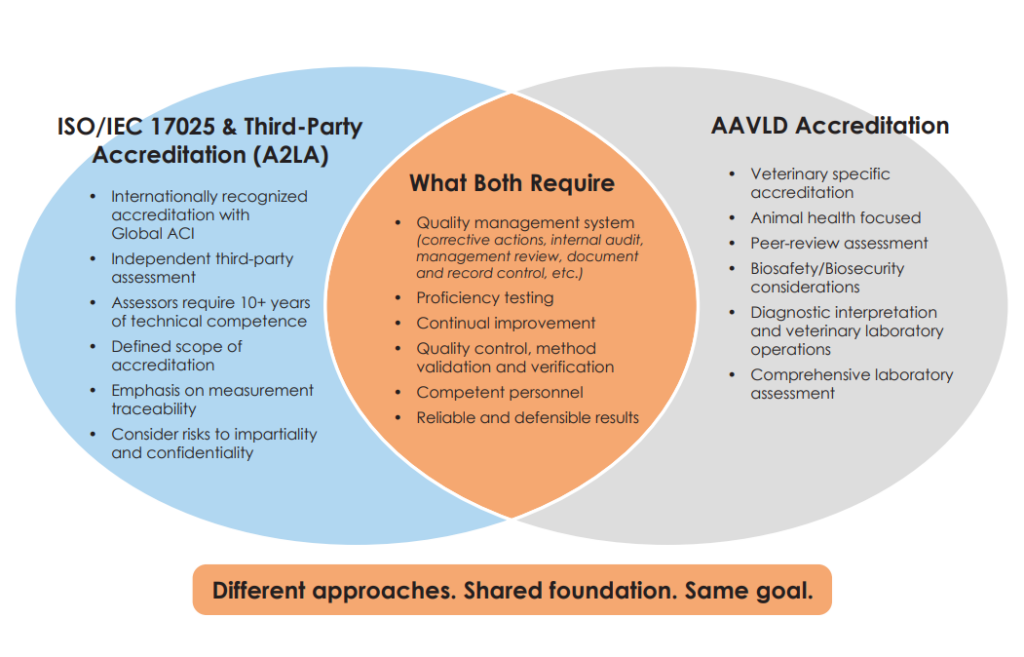
AAVLD and ISO/IEC 17025 are working toward the same goal; a laboratory that can consistently produce accurate, reliable, and defensible results. Both expect laboratories to have a solid quality system behind the testing, including qualified personnel, controlled procedures and records, validated or verified methods, properly maintained equipment, quality control, proficiency testing, internal audits, corrective action, risk management, appropriate facilities, and continual improvement. So, while the accreditation process and assessment approach may look different, the day-to-day foundation of quality is very similar. Changing the accreditation pathway does not mean reinventing the wheel. It means building on processes that are already in place and with AAVLD’s requirements closely aligned with ISO/IEC 17025, that creates significant overlap between the two programs and makes the transition or alignment between them much more manageable.
Key Differences
While AAVLD and ISO/IEC 17025 share a strong quality foundation, the biggest differences come down to focus and assessment approach. AAVLD is built specifically for veterinary diagnostic laboratories and uses a peer-review model where experienced veterinary laboratory professionals evaluate the laboratory’s overall diagnostic operations. ISO/IEC 17025, when provided through A2LA, takes a broader, internationally recognized approach focused on demonstrating technical competence within a defined scope of testing. A2LA also provides an independent third-party assessment with contracted technical experts with 10+ years’ experience, versus the veterinary peer-review model. In short, AAVLD brings deep veterinary diagnostic expertise, while ISO/IEC 17025 through A2LA brings independent accreditation, international recognition, and a clearly defined scope of technical competence. These differences do not necessarily make one program “better” than the other, but they provide different ways for a NAHLN laboratory to demonstrate that it is competent, consistent, and capable of producing reliable results.
Why Consider A2LA Accreditation for NAHLN?
For NAHLN laboratories, third party accreditation through A2LA offers practical benefits without requiring a laboratory to reinvent the wheel of the existing quality system. A2LA provides an independent, objective assessment by qualified technical experts with 10+ years of experience and having a clearly defined scope of accredited testing. A2LA’s NAHLN Veterinary Diagnostic Accreditation Program also incorporates ISO/IEC 17025:2017, A2LA requirements, and the NAHLN Quality Standard, so laboratories can build on the systems they already have. A2LA comes onsite every two years to ensure the quality of the laboratories systems. With the overlap between AAVLD and ISO/IEC 17025, laboratories with established AAVLD based quality systems already have a strong foundation. The goal isn’t more work, it’s leveraging the quality work already being done while adding the value of independent, internationally recognized accreditation.
Conclusion
AAVLD and ISO/IEC 17025 are not competing philosophies; they are two closely aligned ways to demonstrate laboratory quality and competence. For NAHLN laboratories, AAVLD brings valuable veterinary expertise and peer review, while third party ISO/IEC 17025 accreditation through A2LA adds independence, a defined scope of competence, and broader recognition. For laboratories looking to strengthen credibility and demonstrate that their results meet a recognized international standard, A2LA provides an opportunity to build on the quality systems already in place. It’s about giving NAHLN, regulators, customers, and the animal health community another reason to trust the results when they matter most.
Ready to add ISO/IEC 17025 accreditation to your organization’s credentials? Request your free accreditation quote today!